

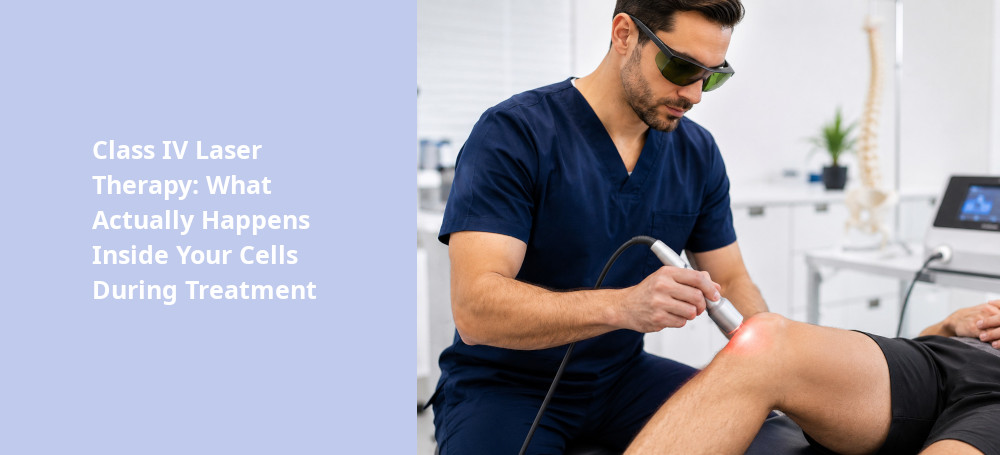
When patients hear the words ‘laser therapy,’ they often picture something from a science fiction movie. The reality is far more practical — and the science behind it is genuinely fascinating. Class IV laser therapy is one of the most powerful tools we use at Healing Star Physical Therapy, and it’s become a cornerstone of treatment for patients dealing with everything from chronic tendon pain to post-surgical recovery. But most people who receive it don’t fully understand what’s happening in their body during those 10 or 15 minutes on the table.
Let’s change that. Here’s exactly what Class IV laser therapy is, what it does inside your tissues, and why it works.
First: What Makes It ‘Class IV’?
Lasers used in medicine and rehabilitation are categorized by their power output. Class I, II, and III lasers — the kind used in barcode scanners, laser pointers, and older ‘cold laser’ devices — deliver very low energy levels. They can interact with superficial tissue but don’t penetrate deep enough to reach muscles, tendons, or joints in a meaningful way.
Class IV lasers operate at significantly higher power levels (typically 1–15+ watts), which allows them to deliver therapeutic energy to structures several centimeters below the skin surface. This depth of penetration is what makes Class IV laser therapy clinically effective for musculoskeletal conditions — and it’s what separates it from the lower-powered devices that have been around for decades.
The laser units used at Healing Star PT are the same technology trusted by training staffs across the NFL, NBA, MLB, NHL, and Olympic programs — not because athletes get special equipment, but because these are simply the devices that work.
The Mechanism: Photobiomodulation
The scientific term for what laser therapy does is photobiomodulation — a word that’s easier to understand when you break it down. ‘Photo’ means light. ‘Bio’ means living tissue. ‘Modulation’ means changing or regulating. So photobiomodulation simply means using light to change how living tissue behaves — specifically, to shift it from a state of dysfunction and pain toward one of healing and normal function.
Here’s what that looks like at the cellular level.
Step 1: Light Hits the Cell
When the laser handpiece is applied to your skin, photons — particles of light energy — penetrate through the skin and into the underlying tissue. The specific wavelengths used in Class IV therapy (typically in the 800–1100 nanometer range, the ‘therapeutic window’ of near-infrared light) pass through skin and fat with minimal absorption, allowing them to reach muscle, tendon, and bone.
Once inside the tissue, these photons are absorbed by specific light-sensitive proteins called chromophores — most importantly, cytochrome c oxidase, a protein found in the mitochondria of virtually every cell in your body.
Step 2: The Mitochondria Wake Up
Mitochondria are the cell’s power generators — they produce the molecule ATP (adenosine triphosphate), which is the universal energy currency that every cellular process runs on. When tissue is injured, inflamed, or under chronic stress, mitochondrial function becomes impaired. The cell is essentially running on low battery — it doesn’t have enough energy to repair itself efficiently.
When cytochrome c oxidase absorbs laser photons, it becomes more active. This triggers a cascade: ATP production increases, the cell has more energy to work with, and the downstream effects ripple outward through the tissue.
Think of it this way: injured tissue is like a phone at 5% battery. It’s still functional, but it can’t do much. Laser therapy is the charger — it gives the cells the energy they need to do their jobs.
Step 3: The Healing Cascade
With ATP production restored, a series of therapeutic effects unfold:
- Inflammation is modulated — laser therapy doesn’t simply suppress inflammation (which would slow healing) — it modulates it, reducing the damaging excess while preserving the signals the body needs to heal
- Circulation improves — nitric oxide is released, causing local blood vessels to dilate and bringing fresh oxygen and nutrients to the injured tissue
- The lymphatic system is stimulated — metabolic waste, inflammatory byproducts, and excess fluid are cleared from the tissue more efficiently
- Collagen synthesis increases — fibroblasts (the cells responsible for laying down new collagen) become more active, accelerating the repair of tendons, ligaments, and other connective tissue
- Endorphins are released — the body’s natural pain-relieving chemicals reduce pain perception both locally and centrally
- Nerve function is normalized — sensitized or damaged nerve fibers begin to recover their normal signaling thresholds, reducing the hypersensitivity that accompanies chronic pain
What You Feel During Treatment
The most common sensation during Class IV laser therapy is a gentle, comfortable warmth at the treatment site. This warmth is real — it reflects the energy being delivered into the tissue and the vasodilation that follows. Your therapist will keep the handpiece moving throughout the session to distribute the energy evenly and ensure safe delivery.
Treatment sessions typically last 5–15 minutes depending on the area being treated and the condition involved. Most patients find it relaxing. There is no discomfort, no downtime, and you can return to your normal activities immediately after.
After your session, the healing process that was initiated continues for the next 18–24 hours. This is why most patients notice that they feel progressively better in the day or two after treatment — not just immediately following it.
How Many Sessions Does It Take?
Most patients begin noticing meaningful improvement within 3–5 sessions, though acute conditions can respond more quickly. A typical course of care is 6–12 sessions, often performed 2–3 times per week initially and then tapered as the tissue heals.
Research consistently shows that laser therapy produces superior outcomes when combined with manual therapy and exercise — not used in isolation. At Healing Star PT, it’s always integrated into a comprehensive treatment plan, not used as a standalone fix.
Who Is It Best For?
Class IV laser therapy is particularly effective for:
- Chronic tendon conditions — Achilles tendinopathy, patellar tendinopathy, rotator cuff tendinopathy, tennis elbow
- Plantar fasciitis and heel pain
- Arthritis and joint inflammation — knee, hip, shoulder, and spine
- Nerve pain and peripheral neuropathy
- Acute muscle strains and ligament sprains
- Post-surgical healing and scar tissue management
- TMJ pain and jaw dysfunction
- Patients who haven’t responded adequately to exercise or manual therapy alone
A Note on Safety
Class IV laser therapy is FDA-cleared and has an excellent safety record when administered by a trained clinician. The main precautions are straightforward: both the therapist and patient wear protective eyewear during treatment, and the laser is not applied directly over certain areas (active malignancy, the pregnant abdomen, implanted electronic devices). Your therapist will review your health history before recommending laser therapy to confirm it’s appropriate for you.
Is Laser Therapy Right for You?
If you’ve been dealing with pain that hasn’t fully responded to traditional treatment — or if you simply want to recover faster and more completely — Class IV laser therapy may be an excellent addition to your care.
Class IV laser therapy is available at both our Eatontown and Freehold, NJ locations. Ask your Healing Star PT therapist whether it’s a fit for your condition, or call either location to schedule a consultation.
Ready to Learn More?
We now offer dry needling at both of our New Jersey locations:
Eatontown, NJ: 145 Wyckoff Rd, Suite 102 — (848) 208-2721
Freehold, NJ: 501 Iron Bridge Road, Suite 2 — (732) 272-1438
Leave A Comment