

Dry Needling
Targeted Relief for Muscle Pain, Tightness, and Trigger Points
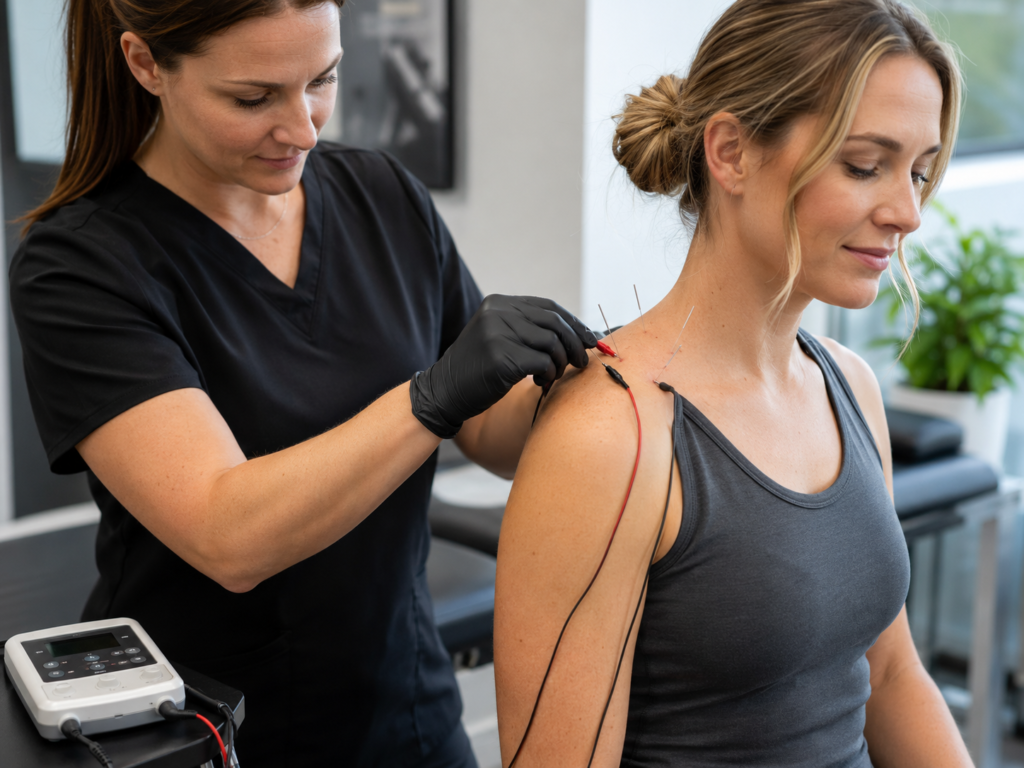
Dry needling is a highly effective, evidence-based treatment technique used by our physical therapists to address muscle pain, dysfunction, and restricted movement. Using a thin, sterile filiform needle — similar to those used in acupuncture — your therapist inserts it directly into a trigger point: a tight, hypersensitive knot within a muscle that can cause local pain or refer pain to other areas of the body.
The term ‘dry’ refers to the fact that no medication or substance is injected. The needle itself stimulates the muscle tissue, elicits a localized twitch response, and triggers the body’s natural healing mechanisms — reducing tightness, improving blood flow, and restoring normal muscle function.
How Is Dry Needling Different from Acupuncture?
While both practices use thin needles, they differ significantly in philosophy and application. Acupuncture is rooted in Traditional Chinese Medicine and focuses on balancing the body’s energy flow along meridian pathways. Dry needling is grounded in Western anatomy and musculoskeletal science. Our physical therapists use it as one component of a comprehensive rehabilitation program to directly target dysfunctional tissue and restore pain-free movement.
How It Works — The Trigger Point Mechanism
Trigger points are localized areas of sustained muscle contraction and metabolic distress. They form after injury, overuse, or chronic tension, and become self-perpetuating — restricting blood flow, accumulating metabolic waste, and referring pain to distant areas of the body. The needle provokes a localized twitch response in the trigger point, which breaks the contraction cycle, normalizes muscle fiber length, and initiates a cascade of healing in the tissue.
Electrical Stimulation with Dry Needling
At Healing Star PT, dry needling is frequently paired with electrical stimulation — where a low-level electrical current is applied through the needle to the target muscle. This combination further relaxes the muscle fiber, enhances trigger point release, improves circulation to the tissue, and reduces post-treatment soreness. Your therapist will determine whether e-stim is appropriate for your condition.
Ultrasound-Guided Dry Needling
Now available at Healing Star PT — ultrasound-guided dry needling combines the therapeutic power of dry needling with real-time imaging for enhanced precision, safety, and results.
In standard dry needling, your therapist uses their hands and clinical knowledge to locate trigger points and guide needle placement. Ultrasound-guided dry needling takes this a step further by using a live musculoskeletal ultrasound image on-screen during the procedure. Your therapist can see the needle in real time as it moves through tissue — along with the target muscle, surrounding structures, and any nearby nerves or blood vessels — making placement more precise and the treatment more effective.
Why Ultrasound Guidance Matters
- Greater precision — the needle can be guided to a specific layer, structure, or region within a muscle that cannot be reliably identified by feel alone
- Improved safety — real-time visualization confirms the needle is clear of nerves, blood vessels, and other sensitive structures
- Access to deeper structures — muscles that sit beneath other layers — such as the subscapularis, iliopsoas, deep hip external rotators, and deep cervical muscles — can be targeted with confidence that isn’t possible with surface landmarks alone
- Visual confirmation — the therapist can confirm the needle is in the intended tissue and observe the tissue response during treatment
- More effective treatment — accurate placement in the center of a trigger point produces a more reliable therapeutic response
When Ultrasound-Guided Dry Needling Is Used
While standard dry needling is appropriate for the majority of trigger point presentations, ultrasound guidance is particularly indicated for:
- Deep muscle targets — iliopsoas (hip flexor), subscapularis (deep rotator cuff), deep gluteal muscles, deep cervical multifidus
- Areas of complex anatomy — the anterior neck, thoracic outlet, and regions near major neurovascular structures
- Patients with significant scar tissue or altered anatomy — post-surgical tissue where normal landmarks are disrupted
- Precise tendon and enthesis treatment — targeting the tendon-bone junction or specific tendon layers in conditions like calcific tendinitis
- Cases where previous standard dry needling has had inconsistent results — ultrasound guidance ensures accurate needle placement when anatomical variation may be a factor
What to Expect with Ultrasound-Guided Dry Needling
The procedure feels similar to standard dry needling — you may experience the same local twitch response and mild, temporary soreness afterward. The addition of ultrasound simply means your therapist applies a small amount of gel to the skin and holds the ultrasound probe near the treatment site while placing the needle. The screen allows both you and your therapist to see exactly what’s happening in real time — many patients find this informative and reassuring.
Ultrasound-guided dry needling is available at both our Eatontown and Freehold locations and can be incorporated into your treatment plan at your therapist’s recommendation or your request.
Conditions Dry Needling Can Treat
What To Expect During Your Session
Your first dry needling session begins with a thorough evaluation. Your therapist will assess your posture, movement patterns, and areas of tenderness to identify the most appropriate trigger points to treat. During treatment, a thin needle is inserted into the target muscle. You may feel little to nothing, or you may experience a brief local twitch or dull ache in the muscle — this is a normal and typically positive sign that the trigger point has been engaged.
Sessions typically last 20–30 minutes and are often combined with manual therapy, therapeutic exercise, or laser therapy for optimal results. Mild soreness for 24–48 hours afterward is common and typically resolves with gentle movement and hydration.
Is Dry Needling Safe?
Yes. Dry needling — including ultrasound-guided dry needling — is a safe, minimally invasive procedure when performed by a licensed physical therapist with specialized training. All needles are sterile, single-use, and disposed of immediately after each treatment. Not everyone is a candidate for dry needling, and your therapist will review your complete health history before recommending it as part of your care plan.
Do I Need a Referral?
New Jersey is a direct-access state — you can begin physical therapy, including dry needling and ultrasound-guided dry needling, without a physician’s referral. Both services are available at our Eatontown and Freehold, NJ locations.
Eatontown, NJ: 145 Wyckoff Rd, Suite 102 — (848) 208-2721
Freehold, NJ: 501 Iron Bridge Road, Suite 2 — (732) 272-1438
Ready to experience the Healing Star difference?
Book an appointment and take the first step toward feeling better.